Teen Girls' School Shoes: How to Balance Style With Your School's Rules
Published on:
Replacing school shoes in the middle of the year can feel more complicated than buying the first pair. The school rules are familiar by now, but a teenager may have a much clearer idea of what she does and does not want to wear.
The useful middle ground is not choosing between style and the uniform policy. It is working out the non-negotiable rules first, then using the room left inside them to find school shoes for teenage girls that both parent and pupil are happy with.
What School Uniform Policies Usually Say About Shoes
Secondary school footwear policies vary, so the school's own written policy is always the final reference.
Many schools ask for plain black footwear and may specify leather or a leather-look finish. Some exclude trainers or boots, while others set limits around heels, platforms, decoration, logos or the colour of the sole.
The wording matters. “Plain black shoe” may be interpreted differently from “plain black leather school shoe”, and a policy that bans trainers may treat a trainer-inspired school shoe differently from one that looks clearly like sports footwear.
Do not rely on what another pupil wears or what was accepted in a previous year. If the policy is unclear, checking with the school before buying can prevent an argument after the shoes have been worn outside.
Key Takeaways
- Start with the school's own footwear policy because rules vary between schools.
- “Flat” does not have one universal school definition, so check how your own policy describes heels, soles and platforms.
- Trainer-style shoes, loafers, Mary Janes and lace-ups may all work when their design meets the individual school’s requirements.
- Agree the non-negotiables first, then let the teenager have a real say in the choices that remain.
- Teenage feet may still be growing, so a familiar size does not remove the need to check fit when replacing a pair.
What Counts as a Flat School Shoe?
“Flat” sounds straightforward until you compare two shoes with different soles.
Some school policies use the word to exclude a noticeable heel. Others also place restrictions on platform soles or very deep sole units. There is no single measurement that applies across UK secondary schools.
A low block heel may be accepted by one school and rejected by another. The same is true of a chunky sole.
A chunky sole describes the overall visual depth or weight of the sole. A platform usually raises more of the foot on a noticeably elevated base. Those descriptions can overlap in everyday language, which is another reason to work from the school’s wording rather than the product name.
If the policy says “flat shoes” but gives no further detail, look for any accompanying photographs or footwear examples. When those are not available, ask the school how it applies the rule.
Where Schools Draw the Line on Heels and Platforms
Heel rules often become more specific in secondary school.
Some policies prohibit raised heels altogether. Others allow a low heel but restrict higher, narrow or platform constructions. What matters is the rule your school actually publishes.
A pair can also pass the written policy and still be a poor choice for a full school day. Pupils may be walking between classrooms, climbing stairs, standing at break and travelling to and from school.
That makes comfort part of the decision even when the heel itself is permitted. A shoe that feels awkward after twenty minutes is unlikely to become more appealing after a full timetable.
If a school decides a pair does not meet policy, the pupil may be asked to change into compliant footwear. Checking the details before buying is less frustrating for everyone.
Trainer-Style, Loafer and Lace-Up: What Usually Passes?
There is more variety within school footwear than the words “plain black shoes” sometimes suggest.
Trainer-Style School Shoes
School shoes that look like trainers can appeal to teenagers who prefer a more casual shape. The important distinction is whether the school accepts the design.
A plain black school shoe with a trainer-influenced shape may fit some policies, while visible sports branding, contrasting soles or a construction that reads clearly as a sports trainer may not.
Our older girls' school shoes range covers a mix of these shapes. Use the school’s policy to narrow the options rather than assuming every style in a school category will meet every school’s rules.
Loafers and Mary Janes
Loafers can work well where schools allow slip-on footwear and the sole meets their requirements. Check details such as hardware, decoration and sole depth against the policy.
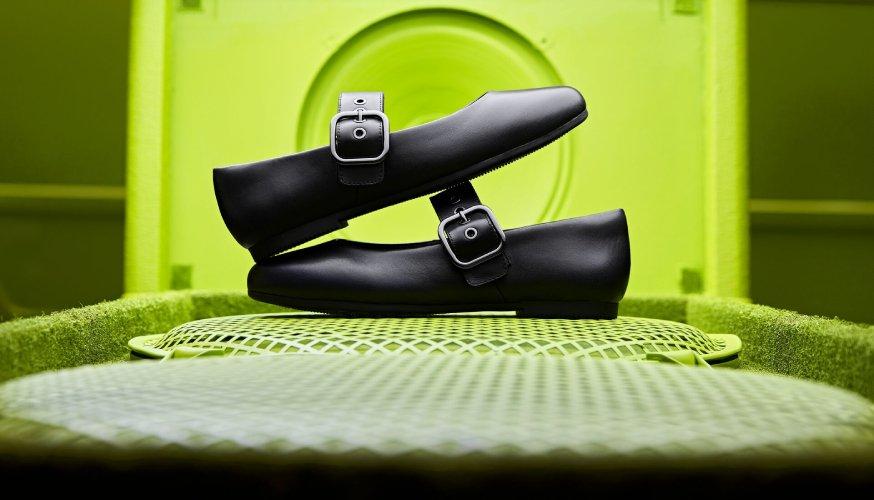
Mary Jane shapes use a strap across the foot and can also work within many uniform requirements. Again, the school’s rules around fastening, decoration and heel height decide whether a particular design is suitable.
Lace-Up Shoes
Lace-ups are often a straightforward option when the policy focuses on plain black footwear. They also allow adjustment across the foot.
Check the whole shoe rather than the fastening alone. Sole colour, detailing and material can still affect whether the pair meets the policy.
Finding a Pair She'll Actually Wear
The most effective way to avoid a pair sitting untouched is to involve the person who will wear it.
Start by agreeing on non-negotiables together. That might be black, no visible branding, no platform and a particular material because those are the school’s rules.
After that, leave real choices open. Shape, finish, fastening and the amount of sole depth may still offer enough variation for a teenager to find something that feels like her choice rather than a decision made around her.
Browsing girls' school shoes together can help establish which shapes both sides would consider before narrowing the options further. If other items need replacing at the same time, you can browse school uniforms in the same place.
There is no benefit in winning the argument at the point of purchase if the shoes then become a daily source of frustration. A pair that meets policy and feels acceptable to the person wearing it is the better outcome.
Growing Feet and Replacing a Pair Mid-Year
When do feet stop growing? There is no exact age that applies to everyone. Growth can continue into the mid-teens and the timing varies between individuals.
That means a teenager who has worn the same size for a while may still need another check when replacing shoes.
Look for practical signs that the current pair no longer fits as it did. Toes may feel close to the end, the upper may press in a new place or the heel may begin to rub.
Clarks fits school shoes with 14mm of growing room, within a fit that still holds the foot securely.
Our Back to School guide covers how to measure and check fit in detail.
If the fit remains uncertain, you can book a fitting with a Clarks expert. Quiet Time appointments are also available for children who find busy shops difficult, and shoes fitted in store come with a three-month fit guarantee subject to the current terms.
Making a Pair Last the School Year
Once the fit is right, a small amount of regular care can help the pair stay usable for longer.
If there is a second suitable pair available, rotation gives footwear time to dry between wears. That can be especially useful through wet weather.
Do not force soaked school shoes dry against direct heat. Our guide on how to dry wet school shoes covers the drying process separately.
Keep an eye on the sole, heel, fastening and upper as the term continues. Surface scuffs do not automatically mean replacement, while structural wear or a change in fit deserves closer attention.
For cleaning, polishing and cases where repair may be possible, use the repair and resole guide.
FAQs about Teen Girls' School Shoes
What School Shoes Are Allowed in Secondary School?
There is no universal UK rule. Many secondary schools specify plain black footwear and may set requirements around material, trainers, boots, heels, platforms, logos or decoration. Check your own school’s written policy before buying.
Do Platform Shoes Count as Flat School Shoes?
That depends on the school. Some policies distinguish between a flat shoe, a chunky sole and a platform, while others use broader wording. If the policy does not explain the distinction, ask the school before choosing a pair.
Are Loafers Allowed in School?
Many schools accept loafers when they meet the rest of the footwear policy, but they are not permitted everywhere. Check requirements around colour, material, sole, heel and decoration.
When Do Girls' Feet Stop Growing?
There’s no single age. For many girls, foot growth slows and stops somewhere in the mid-teens, often a little earlier than for boys, but it varies, so it’s worth checking size whenever you replace school shoes.
How Often Should Teenagers Have Their Feet Measured?
There is no fixed timetable that suits everyone. Recheck when replacing shoes, after noticeable growth or when an existing pair starts to feel different. A fitting can help when the size or width is uncertain.